Fountain Valley, CA · Garage Door Service
Is Your Old Garage Door Worth Fixing, or Done
Fountain Valley homes mostly date to the 1960s and 70s. Here's how to tell if your original door and hardware are worth repairing or ready to replace.
- Repairs & new doors
- Springs & openers
- Serving 4 nearby communities
What Local Conditions Do
Most houses in this part of Orange County went up between 1938 and 1995, with the median landing around 1969, and that's the door and hardware you're likely still looking at if nobody's swapped it. A door built in that era wasn't designed with today's heavier insulated panels or safety cables in mind, and after fifty-plus years of daily cycling, the steel fatigues even if it was never dented. The mild coastal climate here actually works in your favor - no deep freeze cracking seals, no extreme heat warping panels the way you'd see further inland. That's why so many original torsion springs and tracks in this area have lasted this long without catastrophic failure. But mild doesn't mean nothing happens. Salt air drift and routine humidity still corrode springs and hinges slowly, and lubricant that was never reapplied leaves rollers grinding in dry tracks. The result is a door that still closes but takes more effort than it used to, and that extra load is what eventually snaps a spring or pulls a cable off its drum. Knowing your door's likely age bracket matters because parts made before the mid-70s often don't match what's stocked today, and that changes whether a repair is quick or a scramble.
Checking It Yourself
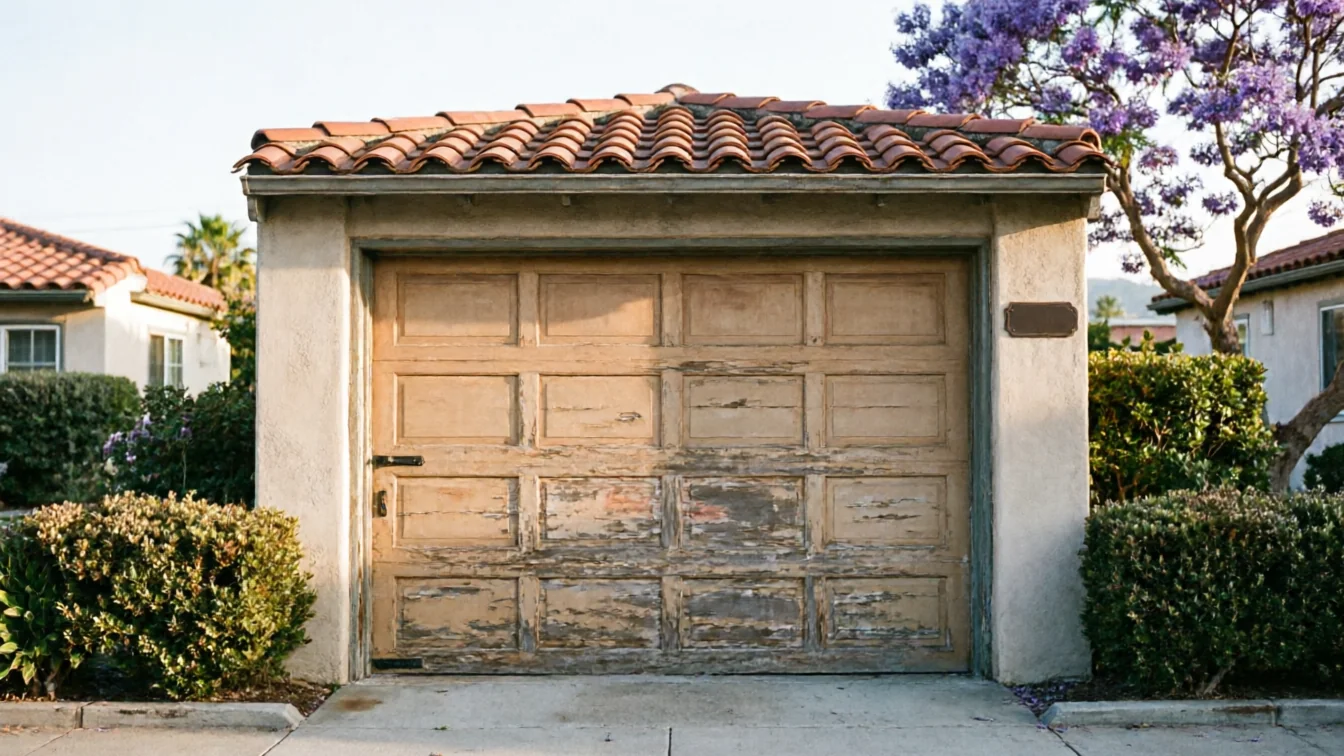
Start with the springs above the door. If you see visible gaps in the coil or rust flaking off in sheets, that's wear built up over decades, not a one-season problem. Lift the door halfway by hand with the opener disconnected - it should hold its position. If it drops or shoots up, the springs are no longer carrying their share of the weight. Next, look at the track mounting brackets. Older installs common to 1960s and 70s construction often used lighter gauge brackets than what's used now, and if they're pulling away from the jamb, that's a structural issue, not just a noisy door. Check the panels themselves for rust-through at the bottom, especially near where sprinklers or hose bibs sit close to the slab. Surface rust is cosmetic. Rust you can push a screwdriver through is not. Finally, run the door and listen. A low grinding usually means dry rollers, cheap and worth fixing. A loud bang followed by the door refusing to move is almost always a broken spring, also usually worth fixing. A door that shudders unevenly on one side points to a bent track, which is sometimes worth straightening and sometimes not, depending on how bad the bend is.
The Problem
The honest problem with doors from this era is that the decision isn't really about the door panel - it's about what's behind it. A single-panel steel door from the 1960s or 70s stock common across this area can often take a new spring, new rollers, and new cable for a fraction of replacement cost, and that's money well spent if the panel itself is still straight and rust-free. But once the track brackets are pulling loose, or the bottom panel has rusted through near the slab, you're not fixing a door anymore - you're patching a frame that will keep failing. We won't talk you into replacing a door that just needs hardware. We also won't keep selling you spring replacements on a panel that's structurally done. The honest limitation here: we don't make steel panels disappear-rust vanish, and once corrosion has eaten through a load-bearing section, no amount of new hardware changes that math.
The Common Mistake
The mistake we see most in homes built in this 1938-1995 range is replacing the opener and assuming that fixes the door. A stronger opener motor doesn't help a door that's fighting worn-out springs or a bent track - it just works harder against the same resistance until something else gives, usually the new opener's gears. The other common mistake is ignoring a slow-closing door because it still technically works. In a $103,703 median-income area like this, a lot of households can afford to fix things properly rather than patch them repeatedly, but the patch-it-again habit is just as common here as anywhere. If your door is from the original build and it's starting to struggle, get the springs and track inspected before you touch the opener. That one diagnostic step tells you whether you're looking at a $200 repair or a door that's reached the end of what's worth fixing.
Frequently asked questions
My house was built in the late 1960s - is the original door still repairable?
Often yes. If the panel is straight and free of rust-through, a 1960s-era steel door can usually take new springs, rollers, and cable without issue. The hardware wears out long before the panel itself does in this mild climate, so check the steel before assuming the whole unit needs replacing.
Does Fountain Valley's climate affect how long garage door parts last?
The mild coastal temperature band here means less of the extreme expansion and contraction that cracks seals or warps panels in harsher climates. Parts still wear from age and use, but you're less likely to see weather-driven failure than in areas with hard freezes or triple-digit heat.
How do I know if it's the spring or the track that's the real problem?
Disconnect the opener and lift the door by hand. If it's heavy or drops on its own, that's the spring. If it binds, shudders, or moves unevenly on one side as you lift it, that points to a bent or loose track, which is a separate repair.
Related garage door services in Fountain Valley
More garage door guides
Book garage door service in Fountain Valley
Call now or request a quote - tell us what the door is doing and where you are.