
Fountain Valley, CA · Garage Door Service
When a Fountain Valley Spring Finally Breaks on a Cold Morning
Most Fountain Valley homes date to the 1960s and 70s, and this mild climate still delivers one or two cold mornings a year that finish off tired springs.
- Repairs & new doors
- Springs & openers
- Serving 4 nearby communities
What Local Conditions Do
Fountain Valley sits in a mild temperate band, which means nobody here is shoveling snow or scraping ice off a windshield most winters. That same mildness is part of the problem. A torsion spring loses a little bit of tension every time it cools and flexes, and in a place with real winters that cycle happens often enough that owners replace springs on a schedule without thinking about it. Here, the cold only shows up for a night or two at a stretch, so a spring that has been quietly losing temper for years gets no warning signs most of the season. Then one cold snap hits, the metal contracts more than it has in months, and a spring that was already near the end of its life lets go. Add in the housing stock - most of this area was built between 1938 and 1995, with the bulk going up in the 1960s and 70s - and you've got a lot of original or near-original hardware that's now 50 to 60 years old. These springs were never rated for a mild climate's slow, intermittent cold stress; they were just installed, and most owners never think about them again until one snaps.
Checking It Yourself
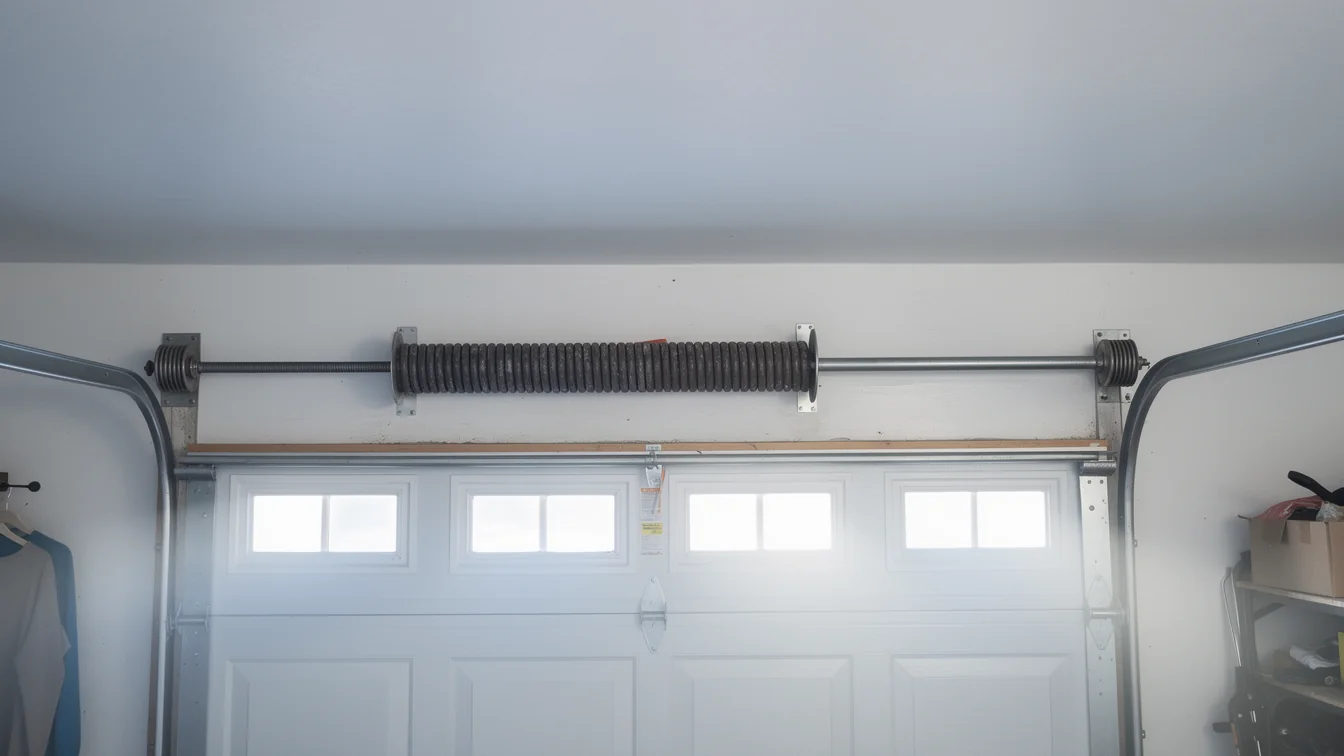
You can do a visual check without touching anything dangerous. Open the garage and look at the spring above the door - if it's a single torsion spring and you see a gap in the coil, it's already broken, even if the door still looks like it opens. Check for rust streaking down from the spring, which tells you moisture has been sitting on it longer than it should. Lift the door halfway by hand with the opener disconnected: it should hold its position on its own. If it drops or you have to muscle it, the spring is losing tension even if it hasn't snapped yet. Listen for a loud bang from the garage on a cold morning - that's usually the spring letting go, not the opener. What you should not do is touch the spring itself, loosen the set screws, or try to wind it back to tension. Torsion springs are under enough stored force to break a wrist or worse, and that's true whether the spring is five years old or fifty. Checking is fine. Adjusting is not a homeowner job.
The Problem
A torsion spring works by winding and unwinding thousands of times over its life, and every cycle it goes through, it gives up a tiny bit of its tensile strength as the metal fatigues. Heat and cold both affect that process, but cold is worse: metal contracts, the coil tightens slightly, and the stress on any weak point in the steel goes up right when the spring has the least flex left to give. In a mild climate like Fountain Valley's, this doesn't happen gradually across a long winter - it happens suddenly, on the handful of mornings each year when the temperature actually drops. That's why a spring can look and sound fine for months and then fail without warning on one specific cold morning. Given that most houses in this part of the service area went up in the 1960s and 70s, a large share of the original springs have had fifty-plus years of cycling behind them already. They're not failing because of one bad morning - the cold snap is just the final push on a spring that was already near its limit.
The Common Mistake
The mistake we see most is owners assuming a mild climate means garage door springs don't need attention here the way they would somewhere with harsh winters. That logic skips over the age of the hardware itself. A spring installed when a house was built in 1968 doesn't care that Fountain Valley rarely sees frost - it cares about cycle count and age, and both keep climbing whether or not the weather ever gets dramatic. The second mistake is replacing only the spring that broke. Most garage doors here run on two torsion springs of matched age, and if one has fatigued enough to snap, the other has been through the identical number of cycles and is close behind it. With a median household income of $103,703 across this area, most owners can afford to replace both at once rather than pay for a second service call a few months later when the matching spring goes. We won't talk anyone into replacing a spring that still has real life left in it, but if the one that broke came off the original installation, the other one is not far behind.
Frequently asked questions
Why did my spring break on a cold morning if Fountain Valley barely gets cold?
It doesn't take a hard freeze. A spring that's already fatigued from decades of cycling only needs the metal to contract a little more than usual to finally give out, and a mild cold snap does exactly that. The weather is the trigger, not the real cause - the real cause is age.
How old are most garage door springs in this area?
Housing in this part of Orange County was mostly built between 1938 and 1995, with the heaviest concentration in the 1960s and 70s. A lot of garage doors still carry original or first-replacement springs, which puts a large share of local hardware somewhere between 30 and 60 years old.
Should I replace one spring or both?
If your door runs on two torsion springs and one just broke, the other has been through the same number of open-and-close cycles since installation. It's usually close behind. Replacing both at the same time avoids a second failure and a second service call a few months later.
Can I tighten or adjust a torsion spring myself?
No. A torsion spring stores enough force to cause a serious injury even when it looks stable. Checking for gaps, rust, or a door that won't hold its position by hand is safe. Adjusting tension or replacing the spring itself is not a homeowner task.
Related garage door services in Fountain Valley
More garage door guides
Book garage door service in Fountain Valley
Call now or request a quote - tell us what the door is doing and where you are.