Fountain Valley, CA · Garage Door Service
Garage Doors on Fountain Valley's Pre-Insulation Housing Stock
Fountain Valley homes mostly date to 1969, before insulation codes existed. Here's what that means for your garage door, spring load, and panel weight today.
- Repairs & new doors
- Springs & openers
- Serving 4 nearby communities
What Local Conditions Do
Fountain Valley's housing stock runs from 1938 to 1995, with the median build year sitting at 1969. That matters more than most homeowners realize. Insulation requirements for garage doors didn't exist when most of this city went up. A door built to match a house from that era is a single layer of steel or aluminum with no foam core, no thermal break, and often no weatherstripping beyond a thin strip along the bottom edge.
The mild temperate climate here has been kind to those original panels in one sense - no freeze-thaw cycles cracking seams, no deep cold snapping springs. But it hasn't done anything to fix the weight and balance problems that come with age. A 1960s-era door, even a well-kept one, is often heavier per square foot than a modern insulated door of the same size, because the steel itself had to do the structural job that foam core does today.
What this means in practice: springs sized for the original door often don't match if a previous owner swapped in a heavier replacement door without re-checking spring tension. That mismatch shows up as a door that struggles halfway up, or an opener straining on every cycle.
Checking It Yourself
Pull the release handle and lift the door by hand, slow and steady, no opener. A door that's properly balanced for its weight should feel light and stay roughly where you let go of it between waist and shoulder height. If it drops on its own or you're fighting it upward, the spring tension is off for the door you actually have - common in a city where median build year is 1969 and doors have been swapped or repaired piecemeal over decades without matching the original hardware spec.
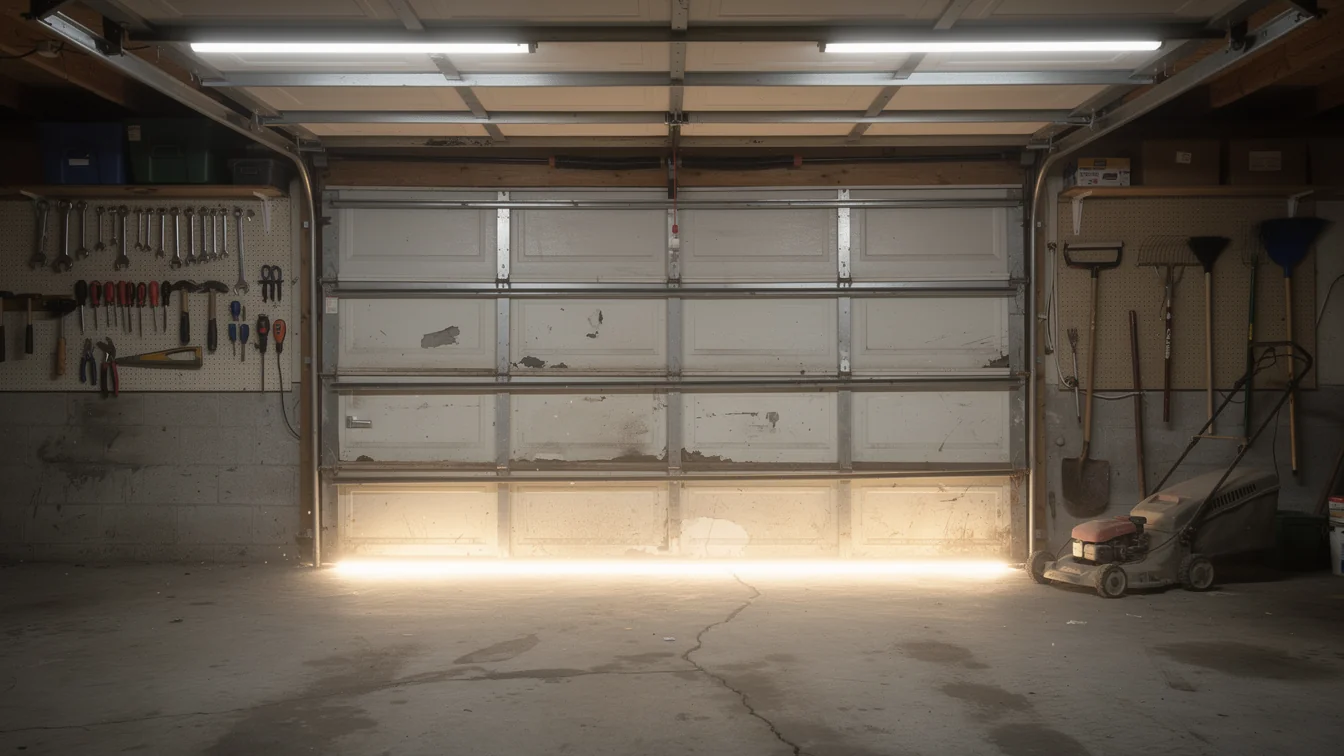
Next, look at the bottom seal. On houses from the 1960s and 70s stock that makes up most of Fountain Valley, the original weatherstrip channel is often narrower than what current seals are sized for. If someone's pressed in a seal that doesn't quite seat, you'll see daylight at the corners even with the door fully down.
Check the panels themselves for flex. Press a palm flat against a panel mid-span. Original uninsulated steel panels from this era flex visibly under hand pressure - that's normal for the material, not damage. If a panel feels rigid and doesn't move at all, it may have been replaced with a foam-core panel that doesn't match the rest of the door's weight, which throws off balance section by section.
The Problem
The core issue isn't that these doors are old - plenty of 1960s steel doors still run fine. It's that the springs, cables, and opener gearing installed decades ago were sized for a door that may no longer be the door on the track. Across the 28 named areas that make up Fountain Valley's older neighborhoods, it's common to find a house with an original frame and track but a replacement door from a different decade, installed by whoever was available at the time without re-torquing the spring to match.
Over-tensioned springs on a lighter replacement door snap the door up hard and wear out cables fast. Under-tensioned springs on a heavier door put the full load on the opener motor, which burns it out years before it should fail. Either way, the mismatch is invisible until something breaks - usually a cable fraying at the drum or an opener gear stripping under a load it was never meant to carry every day.
This is a particular risk in a city built almost entirely in a single 30-year window. The houses age in lockstep, which means the doors, springs, and openers installed or last serviced during that period are aging in lockstep too.
The Common Mistake
The mistake we see most is replacing just the door and assuming the existing spring and track hardware is fine because it's still holding the door up. Holding up and holding up *correctly* are different things. A spring can be under enough tension to lift a door and still be badly mismatched to its actual weight, which just means the opener or the cables are quietly absorbing the difference.
We won't tell you every original 1960s torsion setup needs to be torn out - plenty of that hardware is solid and worth keeping if it's sized right. But swapping a door panel without re-checking spring tension is the single most common shortcut that turns into a service call eighteen months later. If you're pricing a new door for a house from Fountain Valley's typical build era, ask whoever quotes you whether they're re-spec'ing the spring for the new door's weight or just reusing what's on the shaft. That one question separates a job that lasts from one that doesn't.
Frequently asked questions
Why does the build year of my house matter for my garage door?
Fountain Valley's median home was built in 1969, before insulation codes applied to garage doors. That means the original door, spring sizing, and track hardware were all specified for an uninsulated steel panel. If a heavier insulated door has since been installed without adjusting the spring, the balance is off even though the door still opens.
Does Fountain Valley's mild climate mean I can skip maintenance?
The mild temperate climate here spares doors from the freeze-thaw cracking and cold-snapped springs you'd see elsewhere, but it does nothing for age-related wear on hardware from houses built in the 1960s and 70s. Springs and cables still fatigue on a schedule tied to use and age, not weather.
How do I know if my spring matches my door?
Lift the door by hand with the opener disconnected. A properly matched spring holds the door roughly level wherever you stop it. If it drops fast or you have to muscle it up, the spring tension doesn't match the door's actual weight - a common mismatch in homes where the door's been replaced but the spring hasn't.
Related garage door services in Fountain Valley
More garage door guides
Book garage door service in Fountain Valley
Call now or request a quote - tell us what the door is doing and where you are.